


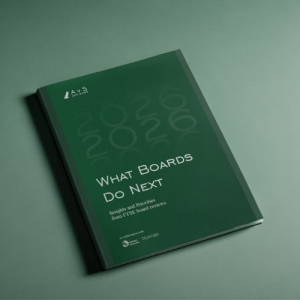
What Boards Do Next 2026
Why half of FTSE boards may be only ‘mediocre’ beyond their core mandate
London, 14 January 2026 — New research analysing board effectiveness reviews across the FTSE 350 finds that while UK boards demonstrate a strong focus on strategic oversight, many fall short across other critical governance responsibilities, including risk oversight, succession planning and ESG.
The report, What Boards Do Next 2026 – Insights and Priorities from FTSE Board Reviews, published by AvS Advisors in collaboration with Better Boards and Normain, is based on an analysis of the most recent annual reports of 350 FTSE-listed companies. It examines disclosed board review results alongside corporate governance reports, offering one of the most comprehensive snapshots of how boards disclose how they allocate attention.
The headline finding is an apparent imbalance in board focus. Strategic oversight dominates board review results, appearing in 80% of companies, making it by far the most consistently disclosed topic. By contrast, risk management appears in just 27% of corporate board reviews, ranking ninth out of ten themes, despite real world events.
“UK boards clearly understand their core mandate,” said Frederik Otto of AvS Advisors. “But beyond strategy, at least half appear to operate at merely mediocre levels across other responsibilities that are increasingly central to resilience and long-term value creation.”
Key findings include:
- Strategic oversight crowds out other priorities
Strategy is the singular dominant theme in board review disclosures, with significantly lower and inconsistent coverage of governance, succession, board dynamics and stakeholder engagement. - Risk oversight remains a persistent blind spot
Risk management and internal controls remain among the least discussed topics in both board review results and follow-up priorities, despite real world events. - ESG is losing salience in board reviews
ESG and sustainability feature in only 21% of corporate board reviews and just 4% among Investment Trusts, suggesting a shift away from ESG as a board-level performance topic. - Engagement with Global Issues is uneven
Only 60% of corporate boards and 50% of Investment Trust boards discuss at least one Global Issue—such as climate, geopolitics, technology or macroeconomic volatility—in their governance disclosures. - Disclosure does not equal prioritisation
Climate and environmental issues dominate corporate governance reporting, appearing in over half of companies, yet are rarely reflected in board review results, pointing to disclosure-driven rather than governance-led engagement.
The report distinguishes clearly between Corporate boards and Investment Trust boards, reflecting their different governance models. Investment Trust boards, which often operate without executive management, perform strongly on leadership effectiveness and board composition but under-index on ESG and strategic oversight.
In addition to quantitative analysis, the report incorporates insights from more than 25 interviews with board chairs, non-executive directors and company secretaries, alongside three closed-door roundtables held in late 2025.
A consistent theme from boardroom interviews was the growing importance of leadership quality and succession planning. As one chair noted: “It’s no longer about knowing everything; it’s about learning faster than the environment changes.”