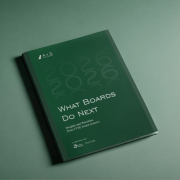



What Boards Do Next examines how FTSE 350 boards are spending their time (and what they are neglecting) based on disclosed board review results and corporate governance reports.
The headline finding is stark: while boards demonstrate a strong focus on strategic oversight, many underreport across other core responsibilities, notably risk oversight, ESG and sustainability, and board composition. The report suggests that UK boards remain compliance-strong but unevenly prepared for an era of sustained geopolitical, technological, and macroeconomic disruption.
The report distinguishes clearly between Corporate boards and Investment Trust boards, reflecting their different governance models. Investment Trust boards, which often operate without executive management, perform strongly on leadership effectiveness and board composition but under-index on ESG and strategic oversight.
In addition to quantitative analysis, the report incorporates insights from more than 25 interviews with board chairs, non-executive directors and company secretaries, alongside three closed-door roundtables held in late 2025.
Key Findings
Strategic oversight dominates
80% of FTSE boards disclose strategic oversight as the primary focus of their board reviews.
Risk oversight remains a blind spot:
Only 27% of Corporate boards reference risk management in board review results; it ranks 9th out of 10 themes.
ESG is being deprioritised:
ESG & Sustainability appears in just 21% of Corporate board reviews and only 4% of Investment Trust board reviews.
Global Issues engagement is partial:
Only 60% of Corporate boards and 50% of Investment Trust boards discuss at least one Global Issue.
Climate dominates disclosure - but not necessarily attention:
Climate & Environment appears in 53% of corporate governance reports, suggesting disclosure-driven reporting rather than board-level prioritisation.
Request your copy
Authors